Hands in Pockets, Eyes on the Mud: Beachcombing the Urr Estuary Without Robbing It
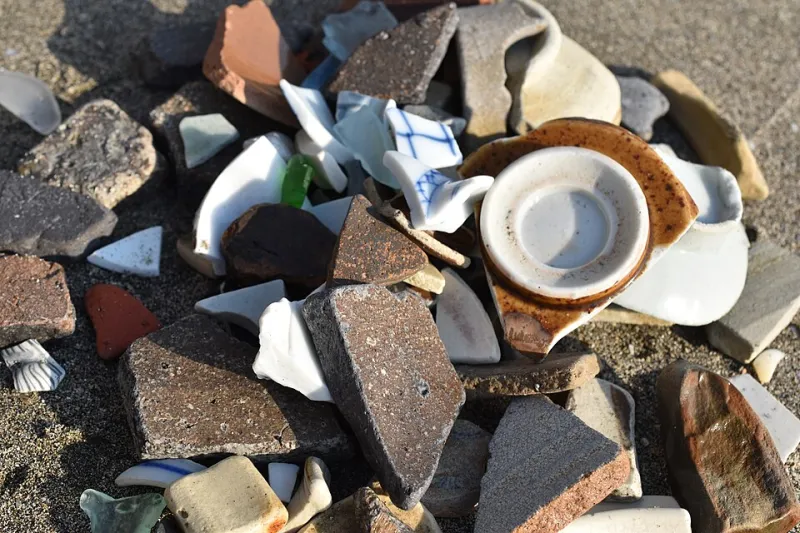
Photo: Fred Cherrygarden, CC BY-SA 4.0, via Wikimedia Commons
Stand at the back door of The Old Mill on a falling tide and the estuary does a quiet conjuring trick. An hour ago there was water; now there is a wide, shining plate of mud, a few channels still draining, and a tideline strung with things the river has been carrying for who knows how long. Guests often ask what they should look for. The honest answer is: look at everything, but be fussy about what you pick up.
Beachcombing on the Urr is not a shopping trip. It is a slow way of reading a working estuary — its boats, its rubbish, its wildlife, its long memory. The best finds are usually the ones you photograph, wonder at, and leave exactly where they are.
First, learn the estuary's manners
Before you start scanning the strandline, check the tide. The Solway moves quickly and the Urr's channels shift; a route that looked firm on the way out can be cut off or soft on the way back. Go on a falling tide, keep an eye on the water, and do not wander far out onto mud that looks solid but isn't. If you are unsure, stay on the paths, the quay area and the firmer edges.
Much of the wider Solway coast is protected for wildlife, and the estuary is a working habitat rather than a blank beach. In winter especially, waders and wildfowl need space. Keep dogs close, avoid pushing birds into flight, and give seals and other animals a wide berth. A beachcomber who disturbs everything to get a closer look is not really beachcombing; they are just making a mess more slowly.
The honest finds, and what they actually are
The Urr estuary is generous with small, ordinary things. Sea glass is common — green, white, amber, occasionally a surprising blue. Most of it began life as bottles, jars or windows, then spent decades being tumbled by sand and water until the sharp edges went soft. Pottery shards turn up too: plain earthenware, bits of blue-and-white, occasionally a piece with a maker's mark worn down to a suggestion. Bricks, tiles and lumps of slag tell of industry and harbour walls. Driftwood arrives in every shape, from elegant to frankly alarming.
Then there are the things that look like treasure but are not yours to keep. A worked flint, an old coin, a piece of ship's fittings, a strange metal object with no obvious purpose: these are the finds that should stop you. In Scotland, archaeological objects — including many things found on the shore — fall under Treasure Trove arrangements. The safe and correct move is to report them, not to scrub them clean and put them in a pocket. Photograph the object where it lies if you can, note the location, and contact the Treasure Trove Unit for advice. Resist the urge to tidy it up. Cleaning can destroy the very information that makes a find interesting.
When a curio is not yours to take
Some objects are protected by law, some are dangerous, and some are both. Live ordnance is not a myth on the Solway; military debris has washed up on these coasts before. If you see something that looks like a shell, flare, canister or any metal object you cannot identify, do not touch it. Move away, keep others away, and call the police on 999 if there is an immediate danger, or 101 for non-emergency advice. A photograph from a safe distance is useful; a prod with a boot is not.
Sharps and medical waste are another reason to use gloves or a litter picker if you are handling rubbish. Dead birds and animals should be left alone and reported if there is a concern; do not let children handle them. And remember that nests, roosts and protected sites are not collecting grounds. If your find is attached to a living thing, a wreck site, a scheduled monument or a protected area, it stays put.
The same applies to natural objects. Shells, bones, feathers and driftwood may look like free souvenirs, but they are part of the estuary's untidy economy. Driftwood shelters invertebrates; shells are homes and building material; feathers belong to birds that may still need them. Take a photograph, sketch the shape, and leave the actual thing to weather back into the shore.
The case for the empty pocket
There is a quietly radical pleasure in coming home with nothing. A beachcomber's code is not about being precious; it is about keeping the shore interesting for the next person and the next tide. If everyone takes a pocketful of sea glass, the strandline gets thinner. If everyone takes the curious metal thing, the record of the estuary's past disappears into a kitchen drawer.
That does not mean you cannot enjoy a small, man-made find. A single piece of sea glass or a broken bit of pottery is a reasonable memento, provided it is common, safe and not archaeological. The test is simple: would the shore be poorer if everyone did this? If the answer is yes, leave it. If the object is sharp, oily, unidentified or older than your grandmother, leave it and report it.
A slow circuit from the mill
From The Old Mill, the simplest beachcombing walk is also the best: down towards the water, along the firm edge of the estuary where the tide allows, then back by the lanes rather than out across the mud. Go slowly. The point is not to cover ground but to notice it. Look for the line where the last high tide stopped — that is where the day's collection sits. Look, too, at what is growing, feeding and hiding. A curlew probing the mud is a better find than any bit of blue glass.
Back at the mill, we like the idea of a temporary museum: a windowsill where finds can be photographed, admired and then returned to the shore on the next walk. It suits the building. The Old Mill has spent centuries holding on to things — grain, stories, weather — but it has also learned when to let them go.
The code, short version
Check the tide and the weather before you go. Stay off soft mud and out of closed or protected areas. Look more than you lift. Leave natural objects where they are. Take only common, safe, man-made pieces, and only a little. Never touch ordnance or unidentified metal. Report archaeological finds rather than cleaning or keeping them. Keep dogs and children close around wildlife. Wash your hands afterwards. And if in doubt, take a photograph and leave the thing alone.
The Urr estuary will still be there tomorrow. The trick is to make sure it is just as worth reading.